

What if the odd behavior your dog shows minutes before a seizure could buy you time?
Spotting those early changes—pacing, sudden clinginess, staring, or small facial twitches—can let you prepare, keep them safe, and give clear details to your vet.
Seizures affect about 1 in 20 dogs, so knowing these signs matters.
This post walks you through common warning signs before, during, and after a seizure, simple safe steps to take at home, what to monitor, and when to call emergency care.
Key Dog Seizure Warning Signs to Recognize Early

The earliest sign that a seizure might be coming often shows up as a shift in behavior. Your dog seems anxious for no reason. Or maybe they’re suddenly glued to your side when they’re usually off doing their own thing. These moments are called the pre-ictal phase, sometimes the “aura” stage, and they can happen minutes before the actual seizure kicks in. Catching these warning signs gives you time to prepare, keep your dog safe, and track what’s happening.
Research points to around 1 in 20 dogs experiencing a seizure at some point. So they’re not rare. Knowing what the early signs look like can help you stay calm instead of panicking when something’s clearly off.
Not every dog shows the same warning signs. Some don’t show any at all before a seizure starts. But when these early behaviors do appear, they tend to follow patterns you can recognize. Paying attention to small changes in mood, movement, or focus can make a real difference in how you respond.
Common pre-seizure warning signs:
- Pacing back and forth with no clear goal
- Sudden anxiety or nervousness without an obvious trigger
- Hiding in weird places, like under furniture or in a closet
- Seeking extra attention or clinging to you more than usual
- Whining, whimpering, or vocalizing in a worried tone
- Trembling or light shaking, especially in the legs or face
- Small facial twitches around the eyes or mouth
- Unusual staring into space or seeming “not quite there”
Active Seizure Symptoms in Dogs and How to Identify Them

Once the seizure begins, abnormal electrical activity takes over the brain. This is called the ictal stage, and it’s when the most visible symptoms appear. Most seizures are self-limiting. They last anywhere from a few seconds to about one or two minutes. During that time, your dog may lose control of their body and awareness of what’s happening.
Generalized seizures, sometimes called grand mal seizures, are the most common type you’ll see. The dog collapses onto their side, becomes unconscious, and their muscles start contracting in a rhythmic pattern. You might see paddling motions with the legs, like they’re trying to run while lying down. These movements are involuntary. Your dog can’t control them.
Focal seizures are different. They affect only one part of the brain and can look much subtler. A dog having a focal seizure might stay standing or sitting, but you’ll notice repetitive jerking in one limb or twitching on one side of the face. Consciousness can be partially preserved, meaning the dog might still be somewhat aware but unable to stop the muscle movements.
During any active seizure, you may also see drooling, foaming at the mouth, jaw chomping or chewing movements, and loss of bladder or bowel control. These are normal seizure behaviors. They don’t mean your dog is choking or in immediate pain. Seizures aren’t usually painful while they’re happening, though the experience can be disorienting afterward.
| Symptom | Description |
|---|---|
| Collapse | Dog falls to one side, can’t stand or maintain balance |
| Limb paddling | Rhythmic kicking or “running” movements while lying down |
| Drooling or foaming | Excessive saliva, often appearing white or foamy around the mouth |
| Jaw chomping | Repetitive chewing, biting motions, or tongue movements |
| Involuntary urination or defecation | Loss of bladder or bowel control during the seizure |
Understanding Dog Seizure Types and What They Look Like
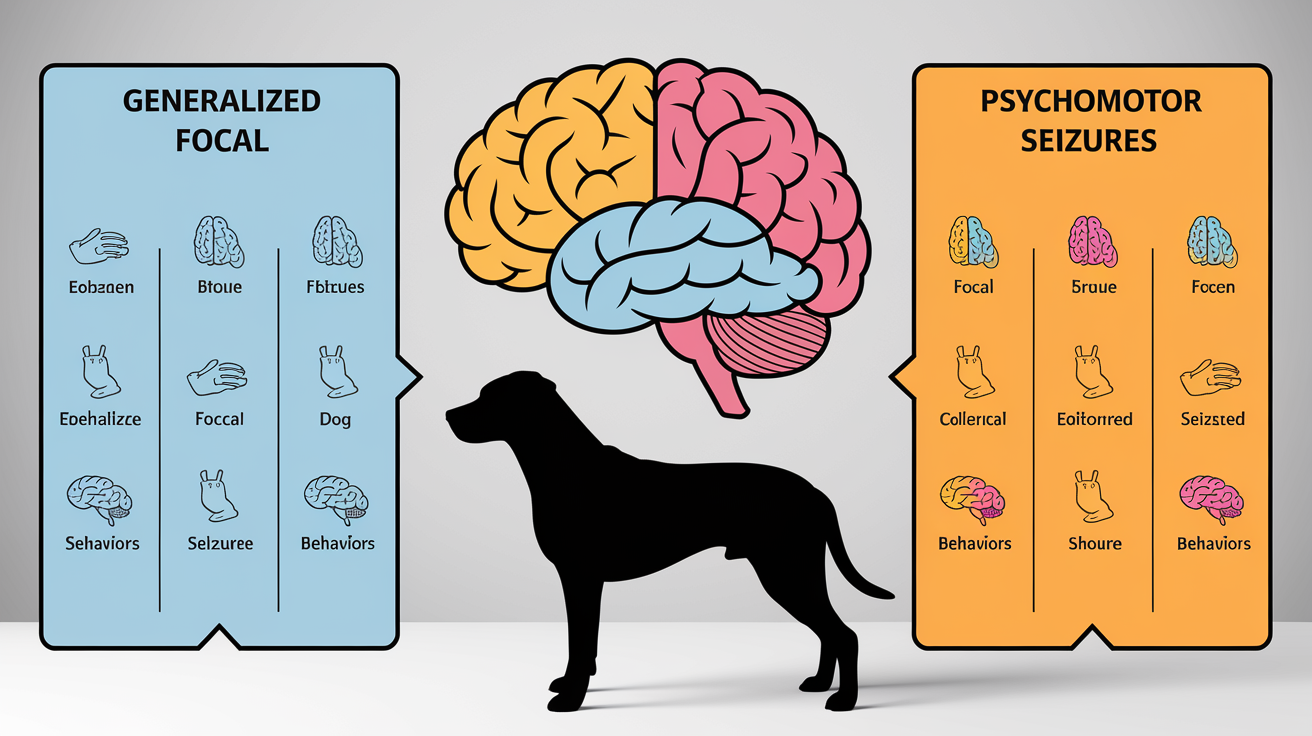
Seizures in dogs fall into a few main categories. Each one looks a bit different. The type of seizure often gives vets clues about what’s happening in the brain and what might be causing it. Some seizures are dramatic and impossible to miss, while others are quieter and can be mistaken for odd behavior or a moment of confusion.
The most common underlying cause of seizures in dogs between 6 months and 5 years of age is idiopathic epilepsy. That means the brain has a tendency to produce seizures without any obvious structural problem or disease. For these dogs, seizures may happen occasionally throughout life, but the brain itself often looks normal on imaging.
Certain breeds are more likely to develop idiopathic epilepsy. Australian Shepherds, Border Collies, German Shepherds, Labrador Retrievers, and Belgian Tervurens are all on that list. Knowing your dog’s breed history can help you and your vet stay alert to early seizure signs.
Generalized (Grand Mal) Seizures
This is the classic “full-body” seizure most people picture. The dog suddenly collapses, loses consciousness, and their muscles stiffen and then jerk rhythmically. You’ll often see paddling legs, chomping jaws, drooling, and sometimes urination or defecation. The episode usually lasts less than two minutes. The dog has no awareness of what’s happening during it.
Focal & Psychomotor Seizures
Focal seizures start in one area of the brain and may stay localized or spread. You might see twitching in just one leg, rhythmic blinking in one eye, or repetitive head movements. The dog may or may not be fully conscious.
Psychomotor seizures are a type of complex partial seizure that causes strange, repetitive behaviors instead of convulsions. Dogs may snap at invisible objects (sometimes called “fly-biting”), chase their tail in tight circles, run in patterns, or stare blankly while moving their mouth. These behaviors look purposeful but are actually involuntary. They tend to repeat in the same way each time.
Post-Seizure Warning Signs and Recovery Behaviors in Dogs

After the active seizure ends, your dog enters the postictal phase. This recovery period can last anywhere from a few minutes to several hours. During that time, the brain is slowly returning to normal function. Your dog may seem confused, tired, or temporarily changed in personality or coordination.
The postictal stage isn’t dangerous on its own, but it can be unsettling to watch. Your dog might not recognize familiar people or places right away. They may act clingy, restless, or unsteady on their feet. Some dogs sleep heavily. Others pace or wander without clear direction. Temporary blindness can happen, where the dog bumps into furniture or walls because their vision hasn’t fully returned yet.
Common post-seizure behaviors to watch for:
- Wandering aimlessly through the house or yard
- Restlessness or pacing even though the dog seems exhausted
- Bumping into objects or acting temporarily blind
- Clinging to you or following you more closely than usual
- Vomiting or dry heaving shortly after the seizure ends
Common Medical Causes Behind Seizure Warning Signs in Dogs

Seizures don’t happen in a vacuum. They’re the brain’s response to something going wrong, either inside the brain itself or somewhere else in the body. Understanding the common causes can help you and your vet narrow down what’s triggering the episodes and what steps to take next.
Reactive seizures happen when something outside the brain, like low blood sugar, liver disease, kidney failure, or toxin exposure, disrupts normal brain function. These seizures are secondary to a medical problem. Treating that underlying condition often stops the seizures.
Symptomatic seizures are caused by structural problems inside the brain, such as tumors, strokes, infections, inflammation, or congenital malformations. These require imaging like an MRI to diagnose. Idiopathic epilepsy, on the other hand, is diagnosed by ruling out other causes. There’s no visible brain damage, but the brain has an inherited tendency to produce seizures.
Age is one of the biggest clues. Puppies under 6 months who have seizures often have metabolic issues, congenital problems, or infections. Dogs between 6 months and 5 years are most likely to have idiopathic epilepsy. Dogs older than 5 years who start having seizures for the first time are more likely to have a brain tumor, stroke, or other age-related structural disease.
| Age Range | Likely Causes | Notes |
|---|---|---|
| Under 6 months | Infections, toxins, metabolic disorders, congenital malformations | Examples include portosystemic shunt, low blood sugar, or distemper |
| 6 months to 5 years | Idiopathic epilepsy (genetic) | Most common cause in this age group; at least 25 breeds are affected |
| Over 5 years | Brain tumors, strokes, other structural brain disease | First-time seizures in older dogs usually warrant imaging and workup |
When Dog Seizure Warning Signs Become an Emergency

Most seizures are short, self-limiting, and not immediately life threatening. But some situations cross into emergency territory. Knowing those thresholds can save your dog’s life. When a seizure lasts too long or happens too many times in a row, the brain can overheat, swell, and suffer permanent damage.
A single seizure that lasts longer than 5 minutes is called status epilepticus. It requires immediate veterinary care. The longer a seizure continues, the harder it becomes to stop, and the risk of brain injury increases. If your dog is still actively seizing after 5 minutes, get to an emergency clinic right away.
Cluster seizures, defined as two or more seizures within 24 hours, are also considered an emergency. Even if each individual seizure is short, the repeated episodes put stress on the brain and body. Cluster seizures often require injectable medications to break the cycle and prevent further episodes.
Emergency thresholds that require immediate veterinary attention:
- Any seizure lasting longer than 5 minutes without stopping
- Two or more seizures within a 24-hour period
- Difficulty breathing, very pale or blue gums, or weak pulse during or after a seizure
- Failure to regain normal consciousness or coordination within a reasonable recovery time
- Collapse or inability to stand after the postictal phase has passed
- Known toxin exposure or trauma before the seizure began
First-Aid Steps to Take When Your Dog Shows Seizure Warning Signs

Once you recognize that a seizure is starting or already happening, your main job is to keep your dog safe and stay calm. Seizures are usually self-limiting. They stop on their own. Your role is to prevent injury, time the event, and gather information that will help your vet.
Move furniture, toys, and any hard or sharp objects away from your dog so they don’t accidentally hit their head or limbs during paddling or thrashing. If your dog is near stairs, gently slide them away from the edge using a blanket or towel, but don’t try to hold them down or stop the muscle movements. Restraining a seizing dog can cause injury to both of you.
Never put your hand, a spoon, or any object into your dog’s mouth during a seizure. Dogs don’t swallow their tongues, and you risk a serious bite. If the seizure lasts longer than a few minutes and your dog seems to be overheating (panting heavily, hot to the touch), you can place a fan nearby to blow cool air over them or wrap cool, damp cloths around their paws to help bring their temperature down gently.
Steps to take during and after a seizure:
- Note the time the seizure starts and ends so you can report the duration to your vet
- Clear the area around your dog to prevent injury from furniture or objects
- Stay calm, speak softly, and avoid loud noises or sudden movements that might overstimulate them
- Don’t restrain your dog or put your hands near their mouth
- Video the seizure if you can do so safely. It’s one of the most helpful tools for your vet
- After the seizure ends, allow your dog to recover quietly in a safe, dim, calm space
- Offer water only once your dog is fully alert and able to drink without choking
How Veterinarians Diagnose Seizure Causes in Dogs

After a seizure, your vet’s first goal is to figure out whether the seizure was a one-time event triggered by something fixable or a sign of an ongoing condition like epilepsy or structural brain disease. The diagnostic process usually starts with a thorough physical exam and a detailed history from you.
Bloodwork is often the first step. Your vet will check for metabolic problems like low blood sugar, liver or kidney disease, and electrolyte imbalances. These tests can identify reactive causes that might be treatable with medication or diet changes. If bloodwork and a physical exam don’t reveal a cause, your vet may recommend advanced imaging, such as an MRI or CT scan, to look for tumors, strokes, or brain malformations. Sometimes a cerebrospinal fluid (CSF) analysis is done to check for infections or inflammation.
Long-term monitoring is key for dogs with recurring seizures. Your vet may ask you to keep a seizure diary, noting the date, time, duration, and any behaviors you observed before, during, and after each episode. This log helps track patterns, assess treatment effectiveness, and decide when medication adjustments are needed.
What to document and bring to your vet visit:
- Video recordings of the seizure, including pre-ictal and postictal behaviors
- Exact start and stop times for each seizure
- Number of seizures and how close together they occurred (cluster patterns)
- Any possible triggers, such as recent vaccinations, new foods, toxin exposure, stress, or temperature extremes
Dog Seizure Treatment Options and Long-Term Management

If your dog is diagnosed with epilepsy or has recurring seizures, your vet will likely recommend starting anticonvulsant medication. The goal is to reduce the frequency and severity of seizures, not necessarily to eliminate them completely. Most dogs can live happy, normal lives with well-managed epilepsy.
Phenobarbital and potassium bromide are two of the most commonly prescribed anticonvulsants for dogs. Both require regular blood tests to monitor drug levels and liver function, since long-term use can affect the liver. Levetiracetam (Keppra) and zonisamide are newer options that may have fewer side effects and don’t always require as much blood monitoring. Your vet will choose a medication based on your dog’s age, health, seizure frequency, and how they respond to treatment.
For dogs with severe seizure disorders, your vet may prescribe rectal diazepam suppositories for emergency home use. These can stop a prolonged seizure or break a cluster cycle before you’re able to get to the clinic. Learning how to use them ahead of time can give you confidence and keep your dog safer during a crisis.
Long-term seizure management strategies:
- Give medication at the same time every day to maintain steady blood levels
- Schedule regular bloodwork to monitor drug levels and organ function
- Keep a detailed seizure diary to track frequency, duration, and triggers
- Avoid sudden changes in routine, diet, or medication that might destabilize seizure control
- Work closely with your vet to adjust doses or add medications if seizures break through
Final Words
Noticing pacing, trembling, or an unusual stare? Those early behaviors can mean a seizure is about to start. Stay calm and keep your dog safe.
This post walked you through pre-ictal cues (early signs before a seizure), what active seizures look like, post-seizure recovery, common causes by age, emergency red flags, basic first aid, and how vets diagnose and treat. Time events, take a video, and remove hazards if a seizure begins.
If you see clear dog seizure warning signs, note what happened, contact your vet for next steps, and follow a simple plan. You’re doing the right thing by watching and preparing.
FAQ
Q: Are there warning signs before a dog has a seizure?
A: Warning signs before a dog has a seizure include anxiety, pacing, hiding, whining, attention-seeking, trembling, facial twitching, and unusual staring—often minutes beforehand. If signs worsen, collapse, or repeat, seek veterinary care promptly.
Q: What can trigger a seizure in a dog?
A: Triggers for a seizure in a dog can include toxins, low blood sugar, liver or kidney problems, brain injury or tumor, high fever, and idiopathic epilepsy; puppies and seniors often have different common causes. New seizures need a vet check.
Q: What can be mistaken for a seizure in a dog?
A: Things mistaken for a seizure in a dog include fainting, vestibular (balance) episodes, sleep attacks, muscle tremors from pain, and panic or behavioral events; noting awareness and timing helps—video the episode and show it to your vet.
Q: What does a silent seizure look like in a dog?
A: A silent seizure in a dog looks like subtle changes—sudden staring, brief disorientation, lip licking, odd repetitive behavior, or short unsteadiness without convulsions. Track and video episodes, and discuss repeating events with your veterinarian.